
Manufacturing
AI automation for manufacturing companies
Automate manual work without replacing your existing systems.
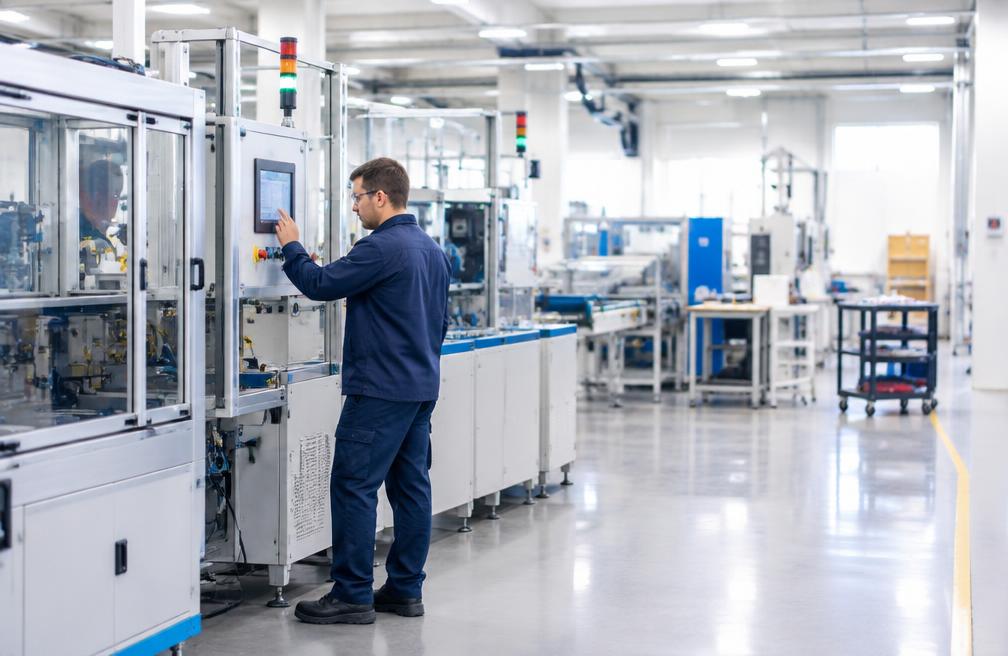
Where does time get lost today?
Orders entered into the ERP by hand
Customer orders from email are retyped by hand.
Production planning in Excel
The schedule is rebuilt by hand every day.
Reports per line done by hand
Figures per line are collected manually.
Purchasing reacts too late
Material shortages are spotted too late.
Where you start
You start with order entry from email into the ERP.
- 1
Receive and read
The order from the email is read automatically: customer, items, quantities and delivery date.
- 2
Check
Is the customer correct, do the items exist, is everything complete?
- 3
Prepare
The data goes into your ERP automatically. Exceptions go to an employee.
What happens with exceptions
In case of doubt, the automation does not decide on its own. An order or notification that is incorrect or unclear always goes to an employee, with a clear explanation of what is missing. Nothing is entered into your systems that is not correct.
What comes next
- Production planning based on orders
- Purchase orders to suppliers
- Daily report per line
Relevant use cases
Process orders from email and PDF
Incoming orders read, checked and entered into the ERP.
View use casesProduction planning based on orders
A planning proposal per line, straight from the orders.
View use casesPurchase orders to suppliers
Purchase orders prepared based on stock and demand.
View use casesFrequently asked questions
Does AI automation also work with an outdated ERP or MES?
Yes. We work with APIs, database reads, Excel exports or even email attachments. Many manufacturers run on systems that are 10+ years old and that is not a blocker.
Do we need to digitise everything before AI makes sense?
No. We start with the steps that are digital enough. Often the first win is automating manual Excel reporting.
How do you handle data security and GDPR?
We work with European hosting, limited data exchange and clear agreements on which data is processed where. Everything is recorded in a data processing agreement.
How quickly do we see results?
A first working automation — for example a daily production report — is usually live within 3–4 weeks.
Is AI automation also suitable for food production and bakeries?
Yes. In food production and bakery environments there is often a lot of manual work around planning, shelf life, quality checks, HACCP, order processing and daily production reporting. That is exactly where AI automation makes processes faster, more consistent and easier to measure.
Which production processes can you automate with AI?
Mainly the information flows: automating order processing, generating production planning from orders, quality and batch registration, and automatic KPI reporting. Automating production and logistics together — from order to delivery — is possible as well.
Is this suitable for the food industry?
Especially there. Process automation in the food industry — from food manufacturers to bakeries and health product producers — is our specialty, including traceability and shelf life.
Where does your team lose the most time?
Book a free 30-minute call. We'll look together at which process to automate first.